53 Patent Claims Filed (2026)
9 Pillars + Sovereign Stack + Secure Data Vault. One Court-Ready Record.

Kill payment fraud before it settles. Prove compliance after it does.

JIL Sovereign makes YES / NO / REVIEW decisions on high-value payments in under 2 seconds, audits 100M historical payments in 10 to 20 minutes, and issues 200ms wallet-risk verdicts - every output a cryptographically sealed, court-admissible record with a 15+ year audit trail, tied to attestation / vendor / profile IDs, and independently verifiable without JIL's cooperation.

$8.3M
Improper-payment exposure surfaced in a 17-min audit of 49.87M Medicare records
<2 sec
Pre-settlement decision across 148 checks, 16 signal categories
15+ yrs
Retention exceeds BSA, FATF, NYDFS, HIPAA floors
What we are · what we are not

JIL is in the attestation, identification, and proof business. We do not pursue funds, file suits, or take contingency on recovered amounts. Clients use our sealed evidence with their own counsel, SIU, FWA team, or regulator referral.

Productized offerings · Sovereign Stack · SDV · Ava · Money Passport
SOVEREIGN · Turnkey in-country deployment
Sovereign Stack - the full platform your government owns, not rents
Three deployment tiers matched to sovereign scope and timeline. Source escrow, perpetual sovereign licence, in-country Sovereign Compliance Network (SCN) validators, post-quantum crypto. Pricing scoped per engagement.
Source Escrow Perpetual Licence
SDV · Digital Safe Deposit Box
JIL Secure Data Vault - the vault that outlives you
Four tiers from Personal to Legacy Plus. Automatic posthumous delivery, quantum-proofed encryption, blockchain-anchored integrity. Time-limited sharing and group family vaults.
Quantum-Proofed Posthumous Delivery
Ava · Retroactive payment integrity for MCOs
Tier 1 detection plus Ava - meet Ava: detect early, prove it, stay safe
Tier 1 retroactive detection plus Tier 2 per-case Ava investigation. Gets MCOs and Medicaid payers inside the 60-Day Rule safe harbor. UBO + bank fingerprinting + premise classification + four-graph network detection. Fixed-fee, no contingency.
60-Day Rule FCA Cooperation Credit CREB-Anchored
MP · Money Passport API suite
Money Passport - credentialed identity for capital flows
Four credential APIs for capital-flow gatekeepers: AccreditedID Issuer (506(c)), ProofOfFunds (title / escrow), SourceOfFunds (exchange / OTC), IncomeVerify (lender / non-QM). Each output is a CREB-anchored verifiable credential.
AccreditedID ProofOfFunds SourceOfFunds IncomeVerify
Designed For
Financial institutions · banks, custodians, exchanges, insurers
Sovereigns · central banks, SWFs, regulators, FIUs
Investigators · trustees, receivers, litigation funders, disclosure counsel
Courts & counsel · law firms, judicial clerks (CourtChain)
Families & private wealth · estate planning (Secure Data Vault)
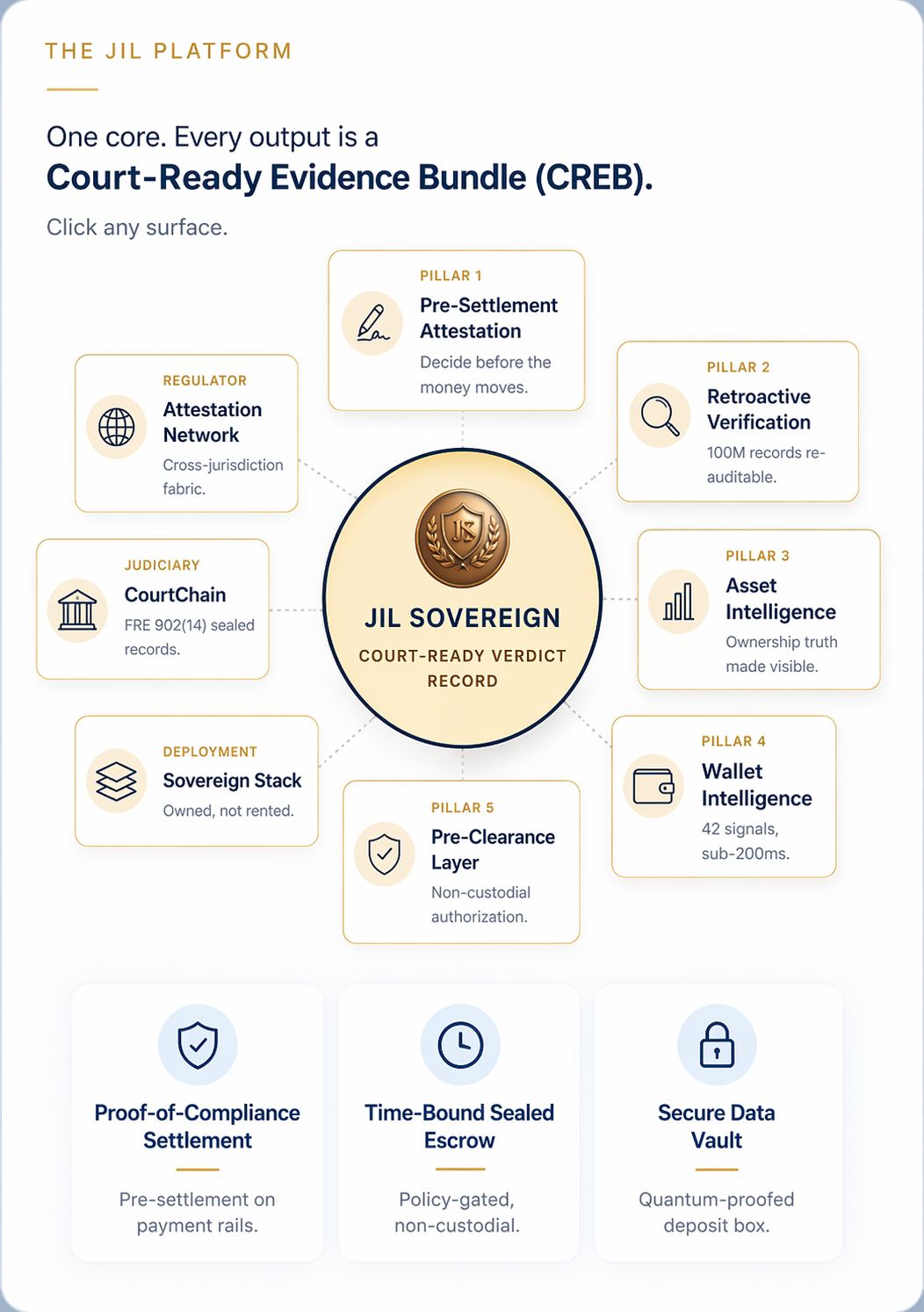
The JIL Platform: 8 regulated surfaces (Pre-Settlement Attestation, Retroactive Verification, Asset Intelligence, Wallet Intelligence, Pre-Clearance Layer, CourtChain, Attestation Network, Sovereign Stack) orbit a single core that produces a Court-Ready Evidence Bundle (CREB™) for every interaction. Three platform surfaces below: Proof-of-Compliance Settlement, Time-Bound Sealed Escrow, Secure Data Vault.
Proof

Built. Running. Verifiable.

53
Patent claims filed (2026)
250
Microservices deployed
10 / 13
Live SCN validators / jurisdictions

Mainnet live. Independently verifiable at /verify/{report_id} without JIL cooperation.

Infrastructure

Infrastructure that settles value

JIL Sovereign is engineered to support high-integrity settlement across jurisdictions, asset classes, and institutions.

A structured, modular architecture designed for operational credibility - from ledger to execution to compliance to multi-jurisdiction resilience.

Core architecture

A unified operating stack

This is not a loose collection of crypto components. It is an integrated settlement architecture composed of ledger, execution, trust, and operational layers.

Unified Ledger (JIL-5600)

A single structured ledger for balances, vaults, positions, routing rules, receipts, impact records, and final settlement state.

Execution Layer (AMM V5)

Batch-based execution designed to improve fairness, reduce manipulation, support routing discipline, and preserve determinism.

Attestation Engine

Evaluates identity, payment origin, source-risk signals, and corridor parameters. Produces a signed attestation result for every transaction. Records are written immutably and returned via API.

Multi-Jurisdiction Operations

Designed to operate across regulated environments with governance discipline, auditability, and resilience.

System view

One layer, four operating domains

The system is partitioned into four distinct layers, each with a clear responsibility and well-defined boundaries.

JIL's infrastructure is legible because each layer has a clear job: the ledger records and reconciles, the execution layer processes and prices, the trust layer evaluates identity, evaluates payment provenance, monitors risk, and produces verifiable policy outcomes, and the operational layer keeps the entire system observable and resilient.

LayerPurpose
LedgerBalances, vaults, positions, routing, proofs, receipts
ExecutionSwaps, settlement, order handling, pricing logic
TrustIdentity evaluation, origin verification, risk assessment, signed result generation
OperationsNodes, monitoring, observability, jurisdictional resilience
Why it matters

Fragmented systems create drag. Unified systems create trust.

Institutions do not just want speed. They want legibility, control, proof, and operating discipline.

A coherent infrastructure layer reduces ambiguity and improves trust. When every component is visible and auditable, institutions can evaluate how the system operates - not just what it claims.

Positioning lock

A unified settlement system, not fragmented infrastructure.

One architecture. One ledger. One compliance surface. One settlement rail.

Compliance posture

Built to the frameworks your auditors, examiners, and counsel already use.

Operational today: FRE 702/901, FATF Travel Rule (FWEA-29), BSA / NYDFS / HIPAA retention (15+ yr floor), OFAC SDN, FinCEN SAR/CTR support, SOC 2 / NIST 800-53 control mapping. In audit through 2027: SOC 2 Type II (Q3 2026), ISO 27001 (Q4 2026), ISO 27017 (Q1 2027), NYDFS Part 500, HITRUST CSF.

Technical Proof

Verifiable mechanics, not marketing claims

Every claim on this site maps to implemented, testable, auditable system behavior. This page shows how.

From identity verification to settlement finality - each component is built, deployed, and operating across 10 active SCN validator nodes in 13+ jurisdictions, scaling to 20 active with 20+ standby.

Settlement lifecycle

Bind. Validate. Prove.

JIL does two things together: verifies that a transaction is allowed before value moves, and records deterministic finality with cryptographic proof when settlement completes.

Step 1

Instruction

Wallet, partner system, or API client submits a signed transaction instruction with beneficiary identity, amount, corridor, and policy parameters.

Step 2

Identity, Origin, and Policy Gate

BID verification, BEC screening, sanctions check, source-account validation, source-rail authentication, funding-path evaluation, KYC/KYB status, corridor policy enforcement, and jurisdictional controls are evaluated before admission.

Step 3

Execution

Deterministic batch execution via AMM V5 - swaps, settlements, and routing processed with fair ordering. No front-running, no MEV extraction.

Step 4

Finality receipt

Cryptographic settlement receipt issued with SCN validator signatures, ledger hash, timestamp, and full audit trail. Immutable, exportable, court-admissible.

Identity verification

Identity, Origin, and Payment Provenance

Beneficiary Identity Dispatch (BID) resolves who is on the other side of every transaction. Business Email Compromise (BEC) screening catches impersonation before funds move. Provenance attestation evaluates payment origin, funding path, and source-rail authenticity after funds arrive.

BID performs document field parsing, PDF metadata anomaly detection, corporate registry verification (OpenCorporates, GLEIF LEI), and cryptographic attestation binding. BEC runs RDAP domain age checks, MX/SPF/DMARC validation, lookalike domain detection, and disposable email blocking. The provenance layer validates source institution regulatory status, traces funding-path hops for layering indicators, authenticates the settlement rail, and flags timing or routing anomalies.

CheckWhat it does
BID RegisterBinds beneficiary identity to a cryptographic attestation with document verification
BID VerifyValidates identity against sanctions lists (OFAC, OpenSanctions/Yente) and registry data
BEC ScreenDomain age, DNS record validation, lookalike detection, disposable email blocking
Person checkPhone, email, address verification with PEP and adverse media screening
Company checkCorporate registry, LEI validation, UBO graph with circular ownership detection
KYC/KYB20-component verification stack with risk scoring (0-100), auto-approve/hold/reject
Security model

MPC custody, post-quantum cryptography, SCN validator consensus

User keys are never held by JIL. MPC 2-of-3 threshold signing means the user always holds a shard - protection coverage without custodial risk.

Bridge operations require 14-of-20 SCN validator consensus (70% BFT). SCN Validator startup follows a 7-gate security sequence. All keys are AES-256-GCM encrypted at rest with post-quantum Dilithium/Kyber readiness.

MPC 2-of-3

User holds 1 shard, JIL holds 1 shard, recovery shard encrypted. No single party can sign alone.

14-of-20 bridge consensus

Cross-chain bridge operations require supermajority SCN validator agreement across 13+ jurisdictions.

5 key types per SCN validator

Ed25519, HMAC, API key, SSH, and HSM keys - each with distinct scope, rotation schedule, and audit trail.

Post-quantum ready

Dilithium (signatures) and Kyber (key encapsulation) implemented for quantum-resistant settlement.

Compliance enforcement

Policy corridors, not afterthought compliance

Every settlement instruction passes through jurisdiction-aware corridor policies before execution. Compliance is not a separate layer bolted on - it is embedded in the transaction path.

Corridor policies define fee rates, throttle limits, and risk tiers. Protected corridors carry 35 bps fees with 3,000/min throttle. Containment corridors - for flagged activity - carry 50 bps with 60/min throttle and mandatory review.

CorridorFeeThrottle
Default25 bps6,000/min
Protected35 bps3,000/min
Unprotected25 bps6,000/min
Containment50 bps60/min + review
Operational proof

10 SCN validators live now, scaling to 20 active + 20+ standby across 13+ jurisdictions

The mainnet is not a roadmap item. It is running across US, DE, EU, SG, CH, JP, GB, AE, BR, and a genesis node - each with independent key material, heartbeat monitoring, and SentinelAI fleet inspection.

10
SCN Validator nodes
250
Microservices deployed
1.2M+
Lines of code
53
Patent claims filed

SentinelAI fleet inspection

Automated threat scoring, heartbeat monitoring, and fleet-wide cycle enforcement across all SCN validators. Max 3 cycles per 2-hour window.

Immutable audit trail

Every compliance decision, identity check, and settlement event is hash-chained and stored in S3 with cryptographic integrity. No retroactive modification possible.

Settlement receipts

Cryptographic finality receipts with SCN validator signatures, ledger state hash, and full transaction lineage. Exportable, verifiable, designed for institutional evidence requirements.

Payment Integrity Economics

Payment integrity economics that scale with trust

JIL earns revenue when payment integrity is established - before and after every settlement. Not from per-check billing, not from token speculation, and not from subscription-only access. Every transaction that flows through the Bi-Directional Payment Integrity Network generates a transparent, auditable fee tied to a specific verification or proof operation. Compliance is embedded. Credentials are reusable. Fees are per-event and policy-driven.

Revenue model

How JIL earns

Live settlement attestation

35-90 basis points per settlement event, negotiated by attestation scope, corridor, and monthly volume. $1 minimum floor per event. Every event returns a cryptographic YES / NO / REVIEW verdict with an immutable on-chain attestation receipt.

Retroactive validation

Historical payment file reconstruction through the same verification engine. Starting at 5 basis points per record, scope and volume priced per engagement. JIL produces the sealed evidence; the client (or their counsel) pursues any downstream recovery. JIL never takes contingency on recovered funds.

BID API - Beneficiary Identity Dispatch

Full-stack identity verification at $0.12-$0.50 per check blended, tiered by engagement. Phone, email, and address checks at $0.03-$0.10. Person verification at $0.20-$0.75. Company and UBO checks at $1.50-$5.00.

Revenue across the portfolio

Five framings. Each priced to its buyer.

JIL Sovereign sells under three framings that sit on the same production infrastructure - 250 microservices, 10 SCN validators across 13 jurisdictions, 14-of-20 BFT quorum, 53-claim patent portfolio, 148 attestation checks (111 universal core + 37 LOB-specific extensions) across 16 categories. Each framing prices to its buyer: architecture to regulators, product lines to institutions, Secure Data Vault to individuals and families. Click each section to expand. Estimate columns are illustrative; final pricing is scoped per engagement.

Architecture · 4 thesis pillars · regulator- and institution-facing RAN, CourtChain, PoCS, Time-Bound Sealed Escrow + cross-cutting commercial models
Product lines · 5 ways to buy · institution-facing Pre-Settlement, Retroactive, Asset Intel, Wallet Intel, Pre-Clearance + bundle synergy

Product line 1

Pre-Settlement Attestation

Live YES/NO/REVIEW verdict before funds move. $25K-$75K setup + 35-90 bps per event. Custodian comparables: 50-200 bps. Integrated with Fireblocks, Anchorage, BitGo, Coinbase Custody.

Buy →

Product line 2

Retroactive Verification

Pre-funded: 5 bps/record (80% off vs real-time). JIL produces the sealed evidence - the client uses it to pursue recovery through their own counsel, SIU, or regulator referral. Typical exposure surfaced: $12-21M on a 200M-record engagement at a $2.0M audit cost.

Buy →

Product line 3

Asset Intelligence

Self-serve tiers: Standard $1,495 (72h), Enhanced $2,995 (48h), Litigator $7,995 (24h). Annual subscriptions for firms and state/federal agencies $150K-$750K.

Buy →

Product line 4

Wallet Intelligence Engine

Developer: $0.12/check pay-as-you-go up to 100k/mo. Enterprise: $0.12-$0.50/check blended by volume above 100k/mo. Full UBO graph, cross-chain clustering, 13-chain coverage.

Buy →

Product line 5

Secure Transport · Pre-Clearance

Custom-scoped integration (4-12 weeks), per-authorization negotiated bps. Card-network comparables: 10-300 bps per sealed authorization. Strategic terms for qualified custodians + central banks.

Buy →

Synergy · Bundle math

Pre-Settlement + Retroactive bundled

50% discount on Retroactive when committed alongside Pre-Settlement. Every Asset Intelligence customer becomes a CourtChain customer. Every Escrow customer needs RAN Institution Export. Cross-sell is baked into the product design.

See all 9 SKUs →
Institutional Annual Tier · MCO + Bank + Healthcare buyers $1.5M-$5M / yr annual subscription. Tier 4 sized below the VP / CCO signoff cap. Retroscan flat-fee entry. CREB™ on every flag.

Healthcare payers (MCO, Regional Blue, hospital systems), banks, P&C carriers, government-adjacent benefits processors, and corporate treasuries buy JIL on an annual subscription with white-glove integration. Every tier sits below the next signoff threshold - Tier 4 ($5M) is set to the typical VP / CCO authority cap so contracts close in weeks, not quarters. Every fraud flag produces a CREB™ (Court Ready Evidence Bundle) - civil-admissible, sealed, and timestamped. We detect and notify; you handle recovery.

Tier 1 · entry institutional

$1.5M / yr

Smaller regional Blue, single-state MCO, mid-size hospital system. Up to 50M tx/yr pre-scan, 500 deep-dives/yr baseline. Pure SaaS API integration - no JIL integration cost. Director / Compliance Lead signoff.

Tier 2 · mid-market

$2.5M / yr

2-5 state MCO, regional bank, multi-hospital IDN. Up to 150M tx/yr, 2,500 deep-dives/yr. Integration SOW capped at $500K (one-time). SVP / Head of Compliance signoff.

Tier 3 · multi-state

$3.5M / yr

6+ state MCO, regional Blue group, super-regional bank. Up to 300M tx/yr, 7,500 deep-dives/yr. Integration SOW capped at $1M. EVP / C-suite direct report signoff.

Tier 4 · national · VP-signoff cap

$5M / yr

National MCO, national Blue, money-center bank, top-5 P&C. Up to 1B tx/yr, 25,000 deep-dives/yr baseline. Integration SOW capped at $2M. Premium intel feeds (Chainalysis, Dow Jones, Refinitiv, OpenCorporates) sold a-la-carte. VP / Chief Compliance Officer signoff - no board approval required.

Entry SKU · flat fee · converts to subscription

Retroactive Audit (Retroscan)

One-time proof-of-value engagement. Run Pillar 2 retroactive sweep on historical claims/payments. $250K for up to 50M payments · $500K for 150M · $750K for 300M. 30-60 day turnaround. 50% credits to Year-1 subscription on conversion within 90 days. Deliverable: flagged-fraud inventory + recovery recommendations + per-flag CREB™.

Deep-dive escalation · client-authorized · pick one

Deep-dive upcharge models

Model A per-settlement $300-$450/event (lowest commitment). Model B prepaid blocks $30K (100x) → $900K (5,000x) for up to 49% volume discount. Model C unlimited subscription +$350K - $1.25M / yr per tier (fair-use 2% of pre-scan volume). All three coexist; client switches between renewals.

Productized offerings · Sovereign Stack + Secure Data Vault In-country sovereign deployment ($2-40M setup) + 4-tier digital safe deposit box ($500-$12K / yr)
Portfolio math · Year-1 through Year-10 Year-1 $20-30M → Year-3 $150-250M → Year-10 $1B+ ARR

Year-1

SDV $6.27M + Asset Intelligence + early PoCS + first CourtChain subscriptions + first 1-3 Institutional Annual contracts. Conservative aggregate $20-30M ARR.

Year-3

SDV $37.4M + RAN hitting $10M+ + PoCS at issuer-adoption inflection + first Sovereign deployments signed + 15-25 Institutional Annual contracts. Aggregate target $150-250M ARR.

Year-10

Sovereign deployments 20-40 live at $1B+ ARR. PoCS at settlement-infrastructure scale. RAN moat compounding. Valuation multiple: sovereign-infrastructure, not compliance-SaaS.

Fee distribution

Where every dollar goes

100%

Settlement Integrity Fees to JIL Operations

100% of settlement integrity fees fund JIL operations - SCN validator infrastructure, attestation services, compliance stack maintenance, and protocol development. No LP splits. No token burns. Every fee maps to a system operation.

10%

Human Flourishing

10% of JIL's profits across all fee types are allocated to Human Flourishing initiatives. Anti-trafficking, financial inclusion, and economic empowerment - funded from our revenue, not a tax on clients.

Industry context

Know your sector's baseline before you run the numbers

Every sector below has documented settlement-layer fraud exposure. JIL's attestation layer addresses the gap between detection and prevention - where 65-80% of annual losses originate.

Industry fraud context

Banking and fintech settlement

$30B+ annual fraud exposure. No cryptographic beneficiary binding. Format-only validation on wire, ACH, and check rails.

Why JIL fits: Beneficiary binding, BEC block, funding-path verification, source-rail authentication, duplicate detection before settlement.

Run the ROI model →

Industry fraud context

Insurance claims and premium settlement

$221B+ annual fraud. No contractor credentialing at disbursement. Post-disaster surge bypasses review entirely.

Why JIL fits: Contractor credentialing, SDV binding, payment-origin verification, anomaly detection, duplicate prevention.

Run the ROI model →

Industry fraud context

Merchant and card-ecosystem vendor settlement

$145B+ annual exposure. Reversible settlement with no cryptographic proof record at payment time. 70% of chargebacks estimated fraudulent.

Why JIL fits: Proof-backed finality, funding-path tracing, fraudulent reversal blocked, BEC vendor protection.

Run the ROI model →

Industry fraud context

Payroll and workforce disbursement

Ghost employees, redirected direct deposits, and contractor impersonation. No identity binding at the disbursement layer.

Why JIL fits: Counterparty verification, source-institution validation, credential-bound payees, duplicate detection.

Run the ROI model →

Industry fraud context

Treasury and cross-border enterprise settlement

Multi-jurisdiction wire fraud, correspondent banking opacity, and BEC targeting CFO/treasury functions. Recovery rate below 18%.

Why JIL fits: Corridor controls, sanctions enforcement, source-rail authentication, payment-origin verification, policy-aware routing before funds move.

Run the ROI model →

Industry fraud context

NGO, ministry, and humanitarian disbursement

Aid diversion, phantom beneficiaries, and opaque last-mile delivery. No attestation layer between allocation and disbursement.

Why JIL fits: Humanitarian routing, funding-path tracing, beneficiary binding, SDV documentation, immutable audit trail.

Run the ROI model →
Settlement capabilities

Why JIL fits

Bi-directional verification

Every payment receives a signed verdict before funds move (outbound integrity) and cryptographic proof after settlement (inbound proof). Results returned via API.

Counterparty and corridor controls

Beneficiary binding, BEC protection, and jurisdiction-level corridor rules enforced before settlement. Ghost vendors and impersonated payees are flagged in the attestation record before settlement - your system acts on the result.

Process-enforced routing

The Automated Transaction Compliance Engine (ATCE) enforces attestation checks per jurisdiction, corridor, and institution. Results are signed, recorded, and returned to your routing system via API.

Unified auditable ledger

Every settlement event produces a cryptographic attestation with SCN validator signatures, ledger state hash, and full transaction lineage. Compliance evidence is generated at settlement, not reconstructed later.

Deterministic receipts

Finality receipts are immutable, verifiable, and tied to specific attestation events. No hidden spreads, no opaque bundling. Every fee maps to a system operation.

Humanitarian routing

10% of JIL's profits are allocated to Human Flourishing initiatives - funded from JIL's own revenue, not a tax on clients. Impact scales with adoption.

Docs landing

Technical documentation

Full transparency into architecture, execution, compliance, operations, and economics.

These are not simplified brochures. They are a proof surface - technical, structured, and dense enough to support institutional due diligence.

Search docs
Overview

What JIL Sovereign is

JIL Sovereign is a settlement-focused operating layer designed for verifiable execution, global interoperability, auditability, and policy-aware control.

The docs layer should clarify that JIL is not simply a new asset story. It is an attempt to unify the most important infrastructure concerns in digital finance: ledger integrity, settlement logic, fair execution, compliance handling, and observable operations.

Architecture

Ledger, execution, trust, operations

The architecture is organized around a unified ledger, execution engine, trust layer, and operational controls.

This should remain technical. Explain the relationship between state, settlement, policy, routing, and system observability in enough detail that technical reviewers can follow the model.

Execution Layer

How value moves through the system

Preserve your strongest differentiator here: proof that the system is real, detailed, and already thought through at implementation depth.

This section is where execution logic, pricing behavior, routing, transaction admission, settlement flows, receipts, and batching strategies should be made inspectable.

Compliance

Policy-aware controls

Explain KYC/KYB posture, jurisdictional logic, off-chain identity references, and how compliance evaluation interacts with settlement and execution without collapsing user trust or system traceability.

Trust engine

Risk monitoring and enforcement

Clarify how the trust layer certifies, monitors, flags, pauses, or governs certain system behaviors, and how those controls are made visible to technical reviewers.

APIs

Integration surfaces

Present wallet, settlement, routing, and system interfaces clearly enough that partners and developers can quickly see how integration might work.

Nodes

Operational architecture

Document consensus posture, node roles, failover concepts, observability, and operating assumptions in a form that feels institutional and auditable.

Economics

System fee logic and distribution

Use this section to explain settlement fees, conversion fees, routing logic, revenue destinations, and operational assumptions without sounding promotional.

Investor narrative

Settlement integrity infrastructure for the $156T cross-border market

JIL Sovereign is the neutral integrity layer between payment instruction and settlement execution. Not a bank. Not a payment processor. Not a blockchain competing for transaction volume. A verification network that every settlement rail needs but none of them provide.

This is an infrastructure economics opportunity, not a token speculation thesis. Revenue logic is defined, the system is built, and the verification layer is positioned for institutional-scale deployment.

53
Patent Claims
250
Services Shipped
13
Compliance Zones
10
Mainnet SCN Validators
Why this matters

Settlement is the monetizable layer beneath the noise

Trading narratives change. Infrastructure narratives endure. JIL is designed to capture the part of the market that every routed flow still depends on.

That means the story is not about short-cycle attention. It is about the long-lived operating layer that global digital movement still requires even as front-end behavior changes.

Settlement is unavoidable and monetizable.
JIL is positioned beneath trading, above messaging, and inside the finality layer.
The system is already built, reducing perceived concept risk.
Economics are legible: live settlement attestation at 35-90 bps per event, retroactive validation starting at 5 bps per record, and BID API verification.
Narrative flow

The investment thesis

Step 1

Massive market

Global digital asset and payment settlement is the layer that everything depends on.

Step 2

Clear problem

Today's systems are fragmented, expensive, opaque, and difficult for institutions to trust.

Step 3

Credible solution

JIL unifies settlement, compliance, auditability, and infrastructure logic in one operating layer.

Step 4

Built proof

This is not futureware. It is already engineered and positioned for go-live readiness.

Revenue architecture

Three institutional revenue streams

Live Settlement Attestation

35-90 bps per settlement event, negotiated by attestation scope, corridor, and volume, with a $1 minimum floor. Covers all 5 settlement integrity pillars: identity verification, payment-origin validation, fraud detection, compliance enforcement, and immutable proof generation.

Retroactive Validation

Historical payment file reconstruction starting at 5 bps per record, scope and volume priced per engagement. JIL never takes contingency on recovered funds - fees are flat or basis-point against attested volume; recovery is the client's downstream action. See full forecast

BID API

Beneficiary Identity Dispatch at $0.12-$0.50 per check blended, tiered by engagement. The entry-point product that gets banks onto JIL infrastructure before full settlement adoption.

Key signals

What sophisticated capital needs to see

Already built. Revenue logic defined. Compliance aware. Institutionally legible.

Those signals reduce friction and increase the likelihood that the inquiry is serious rather than merely curious.

AnalogyThe DTCC for tokenized assets
PositionBi-Directional Payment Integrity Network
Revenue model35-90 bps per settlement event (live attestation, $1 floor). Retroactive validation starting at 5 bps per record. BID API $0.12-$0.50 per check. Implementation $25K-$75K one-time.
Proof250 production services, 53 patent claims, 512M+ certified test cases
NarrativeInfrastructure, not speculation
TrustCompliance-aware, independently audited, institutionally framed
Partnership funnel

Built for banks, fintechs, funds, and strategic infrastructure partners

Start a qualified conversation about policy and settlement attestation infrastructure integration, corridor expansion, or strategic deployment.

We work with institutions and operators that move volume, integrate systems, and expand corridors - organizations where policy and settlement attestation infrastructure creates measurable value.

Start Inquiry
Why partners engage
Verified verification layer
Technical transparency through deep docs
Compliance-native architecture
Legible economics and routing model
Direct inquiry path for serious partners
Partnership types

Different organizations, one clear infrastructure thesis

Identify your organization type and move directly into the right conversation.

Banks

Settlement, compliance posture, corridor expansion, and proof-based infrastructure for digital asset movement.

Fintechs

APIs, settlement rails, routing logic, and auditable transaction flows for modern financial products.

Funds and LPs

Liquidity participation, market structure support, and institution-grade economics visibility.

Infrastructure partners

Custody, compliance, identity, payments, analytics, and strategic ecosystem integration.

Inquiry flow

A cleaner path from curiosity to qualified discussion

A structured path from initial interest to qualified discussion - designed to match institutional rigor.

That means presenting a cleaner funnel: qualification, use-case discovery, technical/compliance review, and then planning toward launch or integration.

Stage 1
Initial inquiry and qualification
Stage 2
Use-case and corridor discovery
Stage 3
Technical and compliance review
Stage 4
Integration planning and launch path
Start inquiry

Open a qualified partnership conversation

Submit your details below and our team will respond within 48 hours.

We welcome inquiries from banks, fintechs, funds, and infrastructure partners. Please include relevant context about your use case or partnership interest.

The Payment Integrity Network - FWEA Verdict Engine

Every transaction gets a cryptographic verdict before funds move.

Yes. No. Review. 148 signal checks (111 universal core + 37 LOB-specific extensions) across 16 categories covering Fraud + Waste + Error + Abuse run in parallel, producing a SHA-256 attested verdict in under 2 seconds. Post-quantum signed. Immutable. Auditable.

The verdict engine is the single authoritative decision point between transaction initiation and settlement finality. No funds move until the verdict is sealed.

Engine metrics
148Total checks (111 core + 37 ext)
15Signal Categories
4+Payment Rails
<1sVerdict Latency
SHA-256 cryptographic attestation
Post-quantum Dilithium signatures
Nacha 2026 compliant
OFAC / sanctions hard block
Verdict model

Three deterministic outcomes. No ambiguity.

Every transaction receives exactly one verdict. The verdict is cryptographically sealed with a SHA-256 hash, timestamped, and stored immutably. No retroactive changes.

YES - Clear to Settle

Aggregate risk score below 30. No sanctions hits. No hard blocks. All 148 signals evaluated (111 core + 37 LOB extensions). Funds may proceed to settlement with full cryptographic attestation.

REVIEW - Hold for Analyst

Aggregate score between 30-70. One or more signals triggered but no hard blocks. Transaction held pending manual analyst review before settlement proceeds.

NO - Settlement Blocked

Score above 70 or hard block triggered. Sanctions match, OFAC jurisdiction hit, or critical fraud indicator detected. Settlement is blocked. Attestation records the denial.

Signal categories

16 categories. 148 parallel checks. One aggregate score.

Each category runs independently and in parallel. Category scores are weighted and combined into a single aggregate risk score. Any sanctions hit overrides to automatic NO.

1. Identity & Counterparty Integrity

7 checks - Weight: 20%

UBO verification, synthetic identity detection, account-to-name validation, real-time sanctions screening (OFAC/EU/UN/HMT), deepfake / presentation attack detection, corporate synthetic fraud, AI voice deepfake at authorization.

2. Payment Rail-Specific Fraud

17 checks - Weight: 20%

BEC, invoice fraud, account takeover, processor impersonation, ACH unauthorized return, APP scam, check fraud (MICR), wire anomaly, SEPA Instant APP, UK FPS CoP, PIX social engineering, UPI fake collect, SWIFT gpi chain substitution, CIPS sanctioned routing, NPP PayID spoofing, digital wallet token provisioning (DPAN), Magecart/e-skimmer.

3. Regulatory Compliance Flags

11 checks - Weight: 15%

Real-time sanctions screening, AML typology detection, OFAC jurisdiction screening, GENIUS Act compliance, BSA/SAR and CTR triggers, EU MiCA stablecoin issuer validation, EU DORA operational resilience, UK FCA authorization, FATF Travel Rule, CBDC attestation framework (eCNY/DEUR/mBridge).

4. Transaction Behavior & Velocity

8 checks - Weight: 15%

Velocity anomaly (1h/24h/7d windows), mule account scoring, high-volume low-value detection, smurfing/structuring ($10K threshold), geographic anomaly, first-party fraud, bust-out credit fraud, dormant account awakening pattern.

5. Settlement Instruction Integrity

7 checks - Weight: 15%

Routing/account change detection with 72-hour hold, beneficiary account age scoring, instruction provenance attestation (hash at initiation vs settlement), credential-registry entity validation, IBAN integrity & beneficiary binding, correspondent chain hop anomaly, real estate closing wire protection.

6. Healthcare & Government Rails

5 checks - Weight: 5%

Duplicate claims detection, provider NPI enrollment verification, upcoding detection, remittance mismatch analysis, overpayment recovery tracking.

7. Macro & Systemic Flags

5 checks - Weight: 10%

Fraud ring graph analysis (IP/device/account clustering), typology sharing pattern library, cross-rail correlation, four-rail coverage verification per OCC/FDIC/Fed mandate, darknet marketplace counterparty exposure.

8. Cross-Jurisdiction Typology Correlation

6 checks - Weight: 5%

FATF international typology pattern matching, Egmont FIU intelligence signals, BIS CPMI payment system risk, cross-border multi-jurisdiction velocity, sanctioned jurisdiction hub routing, trade-based money laundering (TBML).

9. Emerging Threat Intelligence

3 checks - Weight: 5%

Pig butchering / romance-investment scam detection (Chainalysis intelligence), Fraud-as-a-Service (FaaS) infrastructure intelligence, generative AI document & invoice forgery - continuously refreshed threat feeds for emerging typologies.

+ WIE (Wallet Intelligence Engine) - 42 On-Chain Signals

6 additional categories analyze on-chain wallet behavior, counterparty contamination, DeFi trust signals, and hidden asset detection. Combined with the 9 FWEA categories above for a 111-check universal core, plus 37 LOB-specific extensions (Trade Finance, Tax, Deep Sanctions, Cyber, Data Residency, ESG) for a total of 148 checks across 16 categories.

10. Wallet Age & Genesis Risk

6 signals - Weight: 8%

Wallet creation age, funding-to-transaction gap, genesis chain hop, funding source age, single-purpose pattern detection, dormancy spike analysis.

11. Counterparty Contamination

9 signals - Weight: 12%

OFAC direct and 1/2-hop screening, mixer direct and indirect exposure, darknet cluster detection, exploit contract interaction, high-risk exchange exposure, sanctions country origin tracing.

12. Velocity & Pattern Anomalies

8 signals - Weight: 8%

On-chain structuring, fan-out/fan-in ratio analysis, round number bias, off-hours spike, 24h and 7d velocity monitoring, rapid chain-hopping detection.

13. DeFi Trust Scoring

6 signals - Weight: 6% (risk reducer)

Long-term DeFi positions (>365d), protocol diversity (5+ unique protocols), staking age, governance participation, LP duration, lending history. These signals reduce risk score - rewarding legitimate on-chain activity.

14. Hidden Asset Detection

7 signals - Weight: 10%

Undisclosed on-chain holdings vs declared assets, DeFi position mismatch, rapid post-receipt asset movement, hidden LP and vault positions, multisig controller detection, vesting contract claims. Critical for benefits fraud detection.

15. Regulatory Alignment (On-Chain)

6 signals - Weight: 6%

Nacha mule and ATO patterns on-chain, GENIUS Act stablecoin AML, OFAC on-chain screening (hard block), BSA CTR threshold monitoring, FATF high-risk jurisdiction exposure analysis.

Payment rail coverage

All four mandated payment rails. Plus card and crypto.

OCC, Federal Reserve, and FDIC joint mandate requires fraud monitoring across all four payment rails. JIL covers all four plus card networks and crypto rails.

Check

MICR validation, duplicate presentment, routing checksum, altered check detection. Full Positive Pay integration ready.

ACH

Unauthorized return risk (R10/R29), first-time ACH scoring, Nacha 2026 APP false-pretenses compliance, account validation.

Wire

High-risk corridor screening, beneficiary change detection, statistical amount anomaly, first-time international wire flagging.

Instant

APP scam detection, rapid escalation pattern scoring, mule account behavioral analysis, real-time velocity monitoring.

Card

Card testing pattern detection, micro-charge burst analysis, processor impersonation, Mastercard Account Confidence integration ready.

Crypto

GENIUS Act compliance, Travel Rule enforcement (>$3K), stablecoin issuer validation, exchange registration verification.

Verdict flow

Four steps. Sub-second. Cryptographically sealed.

Step 1

Transaction Initiated

Payment instruction submitted with sender, receiver, amount, rail, and metadata. Instruction hash generated and stored.

Step 2

148 Signals Scored

All 15 signal categories execute in parallel. Each returns a 0-100 risk score. Weighted aggregate computed. Hard blocks evaluated.

Step 3

Verdict Issued

Yes, No, or Review. Deterministic. No ambiguity. Includes full signal breakdown, category scores, and triggered reasons.

Step 4

Attestation Sealed

SHA-256 hash generated over verdict, scores, timestamp, and nonce. Post-quantum Dilithium signature applied. Verdict is now immutable.

Regulatory alignment

Nacha 2026 compliance built in from day one

The 2026 Nacha rule changes mandate APP false-pretenses prevention, account validation before ACH origination, and unauthorized debit controls. JIL's verdict engine addresses all three.

APP False-Pretenses
New payee + high amount scoring, rapid escalation pattern detection, social engineering behavioral indicators.
Account Validation
Account-to-name matching, beneficiary age scoring, routing number validation, instruction change hold window.
Unauthorized Debit
ACH return rate monitoring, first-time high-value ACH flagging, R10/R29 unauthorized return risk scoring.
Differentiators

Why JIL's verdict engine is different

Cryptographic Attestation

Not just a flag or a score. Every verdict produces a SHA-256 sealed receipt with timestamp, nonce, and full signal breakdown. Immutable and auditable.

Post-Quantum Signed

Verdicts are signed with Dilithium (NIST PQC standard). Even quantum computers cannot forge a JIL verdict attestation.

Cross-Rail Correlation

Most fraud systems monitor one rail at a time. JIL correlates across all six payment rails - detecting split transactions that no single-rail system can see.

Pre-Settlement

Stops fraud before funds move, not after. No clawbacks, no disputes, no recovery actions. The verdict happens between initiation and settlement.

Instruction Provenance

Payment instructions are hashed at initiation and verified at settlement. Any modification - even a single digit change - is detected and blocked.

Configurable Rules

10 built-in fraud typology rules with adjustable weights and thresholds. Add custom rules via API. Tune sensitivity per rail, per corridor, per entity type.

Ready to stop fraud before settlement?

148 checks. 16 categories. FWEA coverage + LOB-specific extensions. Under-2-second verdicts. Cryptographic attestation. See it in action.

Pricing · Five pillars · Nine SKUs · One integrity layer

Nine ways to buy. Five pillars. One sealed verdict.

From a $1,495 self-serve investigation on a credit card to a $15M+ sovereign deployment for a central bank, every JIL SKU produces the same sealed, 14-of-20 BFT-signed, court-ready verdict record. Pick the pillar that matches what you are trying to prove, then pick the lane that matches how you buy.

Prices on enterprise / sovereign / regulator / judicial SKUs are illustrative estimates. Final pricing is scoped per engagement · contact sales for a firm quote.

What JIL is and is not

JIL is in the attestation, identification, and proof business. We produce sealed, court-ready evidence that a payment, claim, identity, or settlement is what it claims to be. JIL is not a recovery firm. We do not pursue funds, file suits, or take contingent fees on recovered amounts. Clients use our evidence with their own counsel, SIU, FWA team, or regulator referral - we make recovery defensible without owning the recovery action.

01 · Self-serve · Fixed price

Asset Intelligence

One-off forensic investigations. Buy with a credit card, get a sealed verdict record back in 24-72 hours. Court-ready, Federal Rule of Evidence 902(14) configured, independently verifiable at a public verifier URL.

  • Sealed PDF/A verdict record, 14-of-20 BFT quorum signed
  • Independent public verifier at /verify/<record-id>
  • 28-dimension identity integrity engine
  • Appropriate for False Claims Act, probate, civil discovery

For: trustees, litigators, fraud examiners, federal/state investigators, small firms without an engineering integration.

Standard
$1,495
One-time · 72h turnaround
  • SSA Death Master File
  • OIG exclusion / SAM debarment
  • PECOS / NPI status
Buy Standard
Enhanced
$2,995
One-time · 48h turnaround
  • Everything in Standard
  • SOS dissolution, license revocations
  • DUNS / UEI, UBO graph
Buy Enhanced
Litigator
$7,995
One-time · 24h turnaround
  • Everything in Enhanced
  • Address + NCOA tenure, capacity
  • Expert witness declaration available
Buy Litigator
02 · API · Per-lookup

Wallet Intelligence Engine

On-demand wallet screening and identity binding. Sanctions, UBO graph, entity-toxicity scoring, and cross-chain wallet clustering in a single API call. Sub-200ms response at the edge.

  • Per-call verdict with confidence score 0-100
  • 13-chain coverage: BTC, ETH, EVMs, SOL, XRP, XLM, ATOM, HBAR
  • OFAC / OpenSanctions / EU CFSP lists merged
  • OpenCorporates + GLEIF LEI verification

For: exchanges, institutional OTC desks, custodians, fintech risk teams, any product needing pre-transfer wallet screening.

Developer
$0.12/check
Pay-as-you-go · Up to 100k checks/mo
  • REST + webhook endpoints
  • Sanctions + basic entity graph
  • P95 < 200ms response
Request API key
Enterprise
$0.12-$0.50/check
Blended by volume · >100k checks/mo
  • Full UBO graph + cross-chain clustering
  • Custom risk scoring weights
  • Dedicated throughput SLA
Contact sales
03 · Audit-scale · bps or recovery share

Retroactive Verification

Run 4+ years of historical payments through the 148-check Verdict Engine (111 core + 37 LOB extensions). Produces a FWEA Recovery Report with quantified dollar exposure, root cause attribution, and regulator-ready sealed audit artifacts. Per-finding court admissibility at batch-signing cost via inherited-quorum Merkle commitments.

  • Inherited-quorum child attestations (Claim 51)
  • SHA-256 sealed verdict records, optional ZKP proof
  • HHS OIG / CMS ZPIC / DOJ Civil referral format
  • 50% discount when committed alongside Pre-Settlement

For: banks, insurers, MCOs, federal payers, state treasuries, qui tam counsel. Typical engagement 50M-500M records over 4 years.

Pre-funded
5 bps/record
Upfront audit fee · 80% off vs real-time
  • Quantified FWEA exposure report
  • Typical 6-10x ROI
  • 200M tx = $2.0M audit -> $12-21M exposure surfaced
Scope an audit
Outcome-indexed
2-5 bps / attested record
Volume-aligned · same sealed evidence
  • Pay-as-you-attest, no fixed upfront
  • Fee tied to records JIL processes - not to client's downstream recovery
  • Same sealed evidence output
Discuss outcome-indexed
04 · Live attestation · Per-event bps

Pre-Settlement Attestation

Real-time verdict before funds move. 148 compliance checks (111 core + 37 LOB extensions) executed in parallel, 14-of-20 BFT quorum signs, sealed authorization returned to the custodian or bank in under 2 seconds. Every event produces a court-admissible record.

  • Sub-2-second sealed verdict, 148 pre-settlement checks (111 core + 37 LOB extensions)
  • 14-of-20 BFT quorum across 13 jurisdictions
  • Ed25519 + Dilithium-III hybrid signatures (post-quantum)
  • Integrated with Fireblocks, Anchorage, BitGo, Coinbase Custody

For: banks (ACH/wire/RTP), card networks, insurers, payers - institutions where every payment needs a gate and an auditable record.

Setup
$25K-$75K
One-time · 2-6 week deployment
  • API integration + policy engine config
  • MSA + DPA + sanctions screening scope
  • Sandbox then production cutover
Schedule scoping call
Per-event
35-90 bps
$1 floor per event · Volume-tiered
  • Priced by corridor, capability, volume
  • Custodian comp: 50-200 bps
  • Performance + hybrid models available
Model your corridor
05 · Custodian plug-in · Custom-scoped

Secure Transport · Pre-Clearance

Non-custodial authorization layer beneath custody. JIL stands between the custodian and the destination, pre-clears with 14-of-20 BFT quorum, and returns a sealed authorization the custodian executes using its own keys. Architecturally analogous to card-network authorization, applied to institutional digital-asset movement. JIL never holds keys.

  • Non-custodial: JIL never holds, signs for, or controls client keys
  • Destination-rail verification (NYDFS, FCA, MAS, BaFin, FINMA)
  • Sealed authorization, independently verifiable at public verifier
  • Claim 50 architecture (Non-Custodial Pre-Clearance, filed 2026)

For: qualified custodians wanting a compliance plug-in, institutional OTC desks, central banks piloting tokenized settlement, bridge operators.

Integration
Custom
Scoped by custodian + volume tier
  • Fireblocks, Anchorage, BitGo, Coinbase plug-ins
  • Bank + central-bank settlement protocols
  • 4-12 week integration + certification
Scope integration
Per-authorization
Negotiated bps
Per sealed authorization event
  • Priced by size, chain, destination-rail risk
  • Card-network comparable: 10-300 bps
  • Strategic terms for central banks / QCs
Strategic partner inquiry
06 · Pillar 1 · Regulator + operator SKUs

Regulatory Attestation Network

Cross-jurisdictional attestation fabric: FinCEN, OFAC, OCC, EU AMLA, FCA, MAS, JFSA and others issue sealed per-entity compliance credentials. Operators present a single sealed credential to satisfy any participating regime. Regulators gain real-time visibility; operators stop rebuilding a parallel compliance stack in every country.

  • Per-entity signed attestation, cross-regime portable
  • Regulator console, API, and sealed audit exports
  • 14-of-20 BFT quorum across 13 jurisdictions signs every attestation
  • Public verifier - sealed attestations independently checkable

For: regulators, financial-authority free zones, licensed custodians, MSBs and neobanks that operate in multiple jurisdictions.

Operator · per-attestation
$150-$500/entity
Estimate · 12-month credential validity
  • Single attestation satisfies 5+ regimes
  • Volume tiers under $150/entity at scale
  • API + webhook delivery
Request operator access
Regulator · annual license
$500K-$2.5M/yr
Estimate · Scoped by supervised population
  • Full regulator console + supervisor API
  • Sealed audit exports, court-admissible
  • Dedicated compliance SLA + runbooks
Regulator conversation
07 · Pillar 2 · Litigation + judiciary

CourtChain · Litigation-Grade Attestation

Evidence that a court, regulator, or tribunal can accept without a foundation hearing. Sealed verdict records meet Federal Rule of Evidence 902(14), FRE 901 authentication, and Apostille Convention admissibility. Judges get a public verifier; counsel get a chain-of-custody narrative; litigants get an evidence package that survives cross-examination.

  • FRE 902(14) self-authenticating digital record
  • Claim 53 · Civil-admissible sealed verdict record
  • Expert-witness declaration package available
  • Public verifier link · opposing counsel can check independently

For: AmLaw 200 firms, False Claims Act / qui tam counsel, probate and estates, civil fraud, corporate investigators, state AGs, federal / state judiciary.

Per-record
$295
One-time · 24h · Single verdict
  • Sealed PDF/A + JSON
  • FRE 902(14) cover
  • Public verifier URL
Buy one record
Firm subscription
$2,500/mo
Estimate · Up to 25 seats · 50 records/mo
  • Shared case workspace
  • Overflow at $95/record
  • Expert declaration add-ons
Start firm trial
Judicial portal
$0/seat
Estimate · Free for sitting judges + clerks
  • Verdict lookup + bench-memo export
  • Jurisdictional eligibility check
  • Court-integration support pro bono
Judicial request
08 · Pillar 4 · Conditional-release attestation

Time-Bound Sealed Escrow

Cryptographic escrow that releases only when attested preconditions are met - a delivery proof, a dual signature, a regulator clearance, a time window. Non-custodial: the underlying assets stay at the client's custodian. JIL holds only the sealed release-policy attestation. Works for M&A earn-outs, tokenized commercial paper, bridge-loan disbursements, regulated distributions, and CBDC pilot settlements.

  • Policy-gated release with 14-of-20 BFT quorum sealing
  • Time-bound, milestone-bound, or multi-party precondition logic
  • Non-custodial · assets remain at qualified custodian
  • Sealed release certificate - transfer agent / court ready

For: M&A deal counsel, transfer agents, tokenization platforms, commercial paper issuers, structured-finance desks, CBDC corridors.

Per-escrow
$495 + 10 bps
Estimate · Setup fee + value-based
  • Up to 5 preconditions
  • Release certificate + audit trail
  • Up to 12-month escrow term
Scope an escrow
Enterprise program
$25K/mo +
Estimate · Unlimited escrows · Negotiated bps
  • Policy-engine integration
  • Dedicated escrow agent API
  • Volume bps scale down at $500M+/yr
Enterprise escrow
09 · Pillar 5 · Sovereign · Turnkey deployment

Sovereign Stack

Compliance and settlement infrastructure your government owns - not rents. Three tiers scale from a pre-settlement attestation gateway (1-3 months) through a full RAN + CourtChain + settlement layer (6-12 months). Source code escrow, perpetual sovereign licence, in-country deployment with training and support.

  • Full source + perpetual sovereign licence
  • In-country SCN validators · post-quantum crypto (ML-DSA-65)
  • Interoperable with the global JIL attestation network
  • Training, runbooks, incident response, evergreen updates

For: central banks, sovereign wealth funds, ministries of finance, financial-authority regulators, financial free zones.

Full Sovereign Stack page →

Tier 1
1-3 months · Attestation Gateway
$2M-$5M
Estimate · setup + $500K-$1.2M/yr ops
  • Pre-settlement attestation API
  • Regulator dashboard, sealed exports
  • 2 in-country SCN validators
Scope Tier 1
Tier 2
3-6 months · Attestation + CourtChain
$5M-$15M
Estimate · setup + $1.5M-$3M/yr ops
  • Everything in Tier 1
  • CourtChain evidence portal
  • 4 in-country SCN validators + DR
Scope Tier 2
Tier 3
6-12 months · Full sovereign stack
$15M-$40M
Estimate · setup + $3M-$8M/yr ops
  • Everything in Tier 2
  • Sealed escrow + settlement layer
  • 7+ in-country SCN validators, multi-DC
Scope Tier 3
10 · Healthcare LOB · Pre-attestation + verification

Healthcare pricing · predictable contracts, no per-call surprises

For payors, MCOs, and TPAs. Tier 1 pre-attestation runs on a flat annual fee. Tier 2 and Tier 3 either price per-event with budget thresholds, or roll into a single bps rate. Pick the model at signing - we don't switch you mid-contract.

  • 148 attestation checks against OFAC, OIG LEIE, NPPES, GLEIF, SAM.gov
  • HIPAA BAA + Master Services Agreement included
  • CREB™ bundle: Ed25519 + Dilithium-III hybrid signatures, 15-yr retention
  • Free synthetic-data sandbox + KYC-verified signup

For: commercial health plans, Medicaid MCOs, Medicare Advantage organizations, Blue Shield / Blue Cross plans, third-party administrators, FWA programs, SIU teams.

Try the sandbox →

Tier 1
Pre-attestation · every claim, real-time
200ms-800ms
CLEAR / REVIEW / FLAG verdict
  • 148 standard checks
  • Sanctions, exclusion, registry, address, payment-instruction
  • Always on, no escalation
Tier 2
Enhanced verification · auto-fired on escalation
1-4s
Signal-by-signal evidence
  • Deeper provider/member checks
  • UBO graph, BEC posture, doc parsing
  • Payment-instruction-change detection
Tier 3
Full CREB™ bundle · hand-engaged
24-72h
Sealed PDF + JSON, 15-yr retention
  • Court-admissible without our cooperation
  • Expert-witness narrative
  • For HHS-OIG, CMS, MFCU, DOJ

Two pricing tracks. Pick one at signing.

Healthcare claim volumes and PHI/HIPAA constraints make subscription tiers a bad fit. Both tracks below cover the same Tier 1+2 attestation pipeline; they differ only in how cost aligns with throughput.

Track A · Recommended

Flat fee · $1.5M - $5M / year

Tier 1 capacity, sized to claim volume.

  • Tier 1: unlimited within capacity tier; no per-call charges.
  • Tier 2 & 3: per-payment / per-settlement, billed monthly.
  • Auto-process under threshold: Tier 2 fires up to a budget cap you set; Tier 3 above that needs explicit go/no-go.
  • Annual contract; predictable line item your CFO can plan against.

Why most payors pick this: the budget threshold means Tier 2/3 pricing never blocks legitimate work. JIL absorbs the operational risk - you set the cap once.

Track B · Volume-aligned

Basis points · 30 - 90 bps / attested payment

Volume-tiered. Lower bps at higher throughput.

  • Tier 1 + Tier 2: covered by the bps rate. No flat fee.
  • Tier 3: always per-charge negotiated; never bundled into bps.
  • Monthly true-up against actual attested-payment dollar volume.
  • Switch tracks only at renewal so volume data has time to validate.

Best for: payors with seasonal volume swings, or who would rather have cost track receipts than sit as a fixed line item.

One-time engagement

Retroactive Attestation · $150K - $750K flat fee

Run JIL's full attestation pipeline against a defined corpus of historical claims or settlements. Common scopes: M&A diligence, regulator inquiry response, post-incident look-back, internal-investigation evidence, audit committee pack. JIL produces sealed evidence; downstream recovery is the client's action.

50% rebatable as a one-time credit toward a Track A flat-fee contract signed within 12 months. The rebate applies once.

Book scoping call →

FAQ

Why is healthcare priced differently than the other pillars?

Healthcare claim volumes and PHI/HIPAA constraints make subscription tiers a bad fit - payors plan against budgets, not API meters. Flat-fee Tier 1 with thresholded Tier 2/3 maps cleanly to how SIU and FWA budgets are already structured.

How are Tier 2 and Tier 3 budget thresholds set?

During onboarding we look at your historical FWA recovery + investigative spend and propose a monthly threshold. Tier 2 fires automatically beneath; anything above the ceiling, or any Tier 3 case, comes back for explicit go/no-go.

Can we switch from flat-fee to bps mid-contract?

Not mid-contract. Switching tracks happens at renewal so volume data has time to validate the choice. We will model both tracks for you on your real data during scoping so you can see which is cheaper before signing.

What's in the CREB™ bundle?

Subject of verdict, signal-by-signal evidence with source citations, attestation engine version, validator quorum signatures (Ed25519 + Dilithium-III hybrid), 15-year sealed retention, and admissibility narrative. Live samples in the sandbox →

Commercial flexibility

Three ways to engage enterprise buyers

Every product block above maps to one of three commercial structures. Pick by operational certainty vs. outcome alignment.

Basis-Point Infrastructure

One-time setup ($25K-$75K) plus performance-based per-event fees (35-90 bps, $1 floor). Predictable, recurring. Best for mature buyers that want operational certainty.

Outcome-Indexed

Fee scales with the attested-payment volume the buyer routes through JIL. Client pays for verification work performed, never as a contingent share of recovered funds. Best for buyers who want cost to track throughput, not cap-ex.

Hybrid

Recurring infrastructure economics plus savings participation. Strong fit for enterprise conversions after pilot validation - operational certainty plus incentive alignment.

10%
Human Flourishing

10% of JIL's profits across all fee types are allocated to Human Flourishing initiatives. Funded from our revenue, not a tax on clients. Impact scales with adoption.

Not sure which lane fits you?

Four-step qualified intake. We route to the right principal and pre-load context. Two business day response.

Schedule a conversation →